
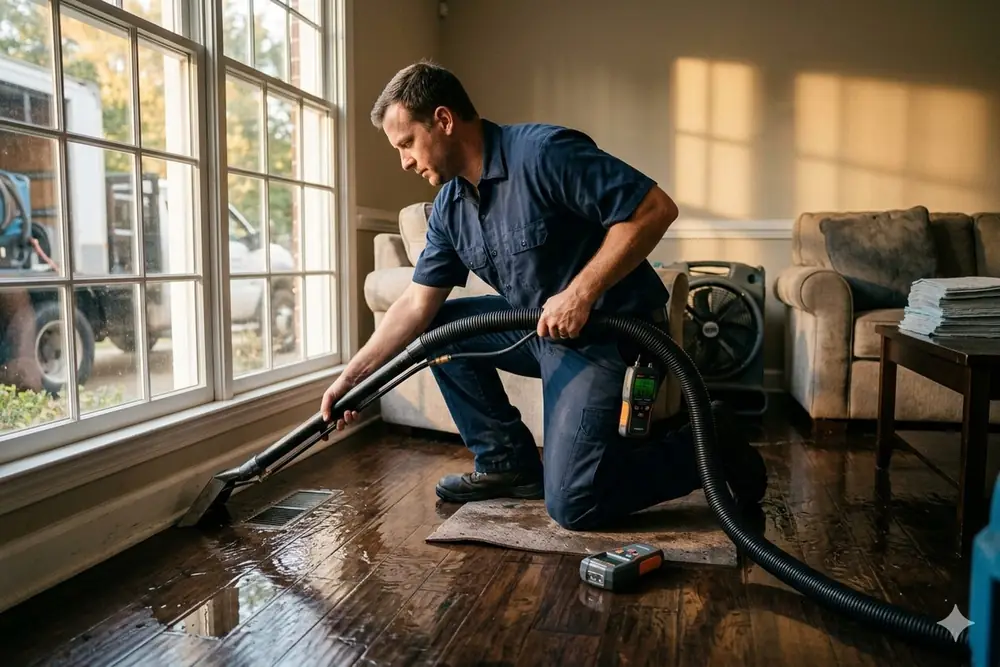
Water Damage Restoration - Drying Measured, Not Guessed
Structural Drying Services Charlotte NC
Structural Drying Services Charlotte NC pick up once standing water is gone but the building itself, subfloor, framing, drywall, is still holding moisture that can't be seen or felt by hand. Drying uses commercial dehumidifiers and air movers placed by calculation rather than guesswork, with daily moisture readings tracked until the wood and drywall drop back to a safe range, not just until the carpet feels dry underfoot. This is water damage restoration Charlotte NC done the right way, with no shortcuts.
[Call Now] · Free on-site assessment · Direct insurance billing · Available 24/7
A room can look completely fine two days after a leak and still be wet inside the wall. Drywall, subfloor, and framing all hold moisture below the surface long after the visible water is gone, and that hidden moisture is exactly what structural drying is built to address, using equipment and daily readings rather than an open window and a box fan.
✨ What Drying Actually Involves
What Structural Drying Services Charlotte NC Include
Drying starts with a moisture map, readings taken at multiple points across affected walls, floors, and framing to establish a baseline. From there, a combination of air movers and dehumidifiers is placed based on the size and shape of the space, not just set up generically in the middle of the room.
The equipment runs continuously, often for three to five days depending on how much moisture is involved and how the affected materials are constructed. Dense materials like plaster or older solid wood flooring hold moisture longer than modern drywall and hold it more stubbornly, which changes how long equipment needs to stay in place.
Daily monitoring is what separates drying from just running fans. A technician returns to take fresh moisture readings at the same points measured on day one, and equipment gets adjusted, or removed, based on how those numbers are trending rather than on a fixed schedule.
What to Expect During the Drying Process
- An initial moisture map with readings recorded at multiple points across the affected area
- Air movers and industrial dehumidifiers placed based on the size and layout of the space
- Daily return visits to re-check moisture readings at the same tracked points
- Equipment removed only once readings confirm materials are back to a safe moisture range
What Happens If Drying Stops Too Early
Pulling equipment because a room feels dry to the touch, rather than because moisture readings confirm it, is one of the most common reasons mold shows up a few weeks after a water event. Framing and subfloor can measure well above a safe moisture level even when the surface feels completely dry. Count on water damage restoration Charlotte NC specialists who answer around the clock.
Where Box Fans and Open Windows Fall Short
A box fan moves air across a surface, which helps a little, but it does nothing to pull moisture out of the air itself, and in Charlotte's humid months an open window can actually add moisture back into a room faster than a fan removes it. Commercial dehumidifiers pull humidity down to a level that lets wet materials actually release the water they are holding.
🕒 How It Works
How It Works
Baseline Moisture Mapping
A technician records moisture readings across walls, floors, and framing to know exactly where the water traveled and how deep it went.
Equipment Placed by Calculation
Air movers and dehumidifiers are set up based on the room's size and the materials involved, not just placed in the center and left.
Daily Monitoring Until Readings Clear
Moisture is re-checked each day at the same points, and equipment stays in place until framing and subfloor are back to a safe range.
✨ The Phase After Extraction
Structural Drying Services vs Emergency Water Extraction
Extraction removes the water you can see, standing puddles, saturated carpet, usually within a few hours of a call. Drying addresses what extraction leaves behind, the moisture that has already worked its way into subfloor, framing, and drywall. Both matter, but drying is the phase that determines whether mold gets a chance to start, since it runs for days rather than hours and depends on measured moisture levels rather than a visual check. It's water damage restoration Charlotte NC property owners trust when every hour counts.
✨ A Typical Call
A Typical Drying Job in Charlotte
A common drying job follows a kitchen supply line leak that ran for a day or two before anyone noticed. By the time extraction is done, moisture readings under the cabinet toe-kick and along the adjoining wall are well above normal, even though the floor no longer feels wet.
Another frequent scenario involves a crawlspace flooded by heavy rain in a home built on the older side of the metro. Because the subfloor sits directly above the crawlspace, drying has to address both the visible flooring above and the joists and insulation below at the same time.
A third scenario comes from a slow roof leak that soaked attic insulation and the ceiling drywall below over several weeks. Drying in this case takes longer than average, since the insulation itself needs to fully release moisture before the drywall underneath can read dry.
Trained to Read the Numbers
Drying is measured, not judged by feel, and technicians are professionally trained to interpret moisture meter readings correctly for different materials, plaster behaves differently than modern drywall, and old-growth wood flooring dries at a different rate than engineered flooring. Getting that reading wrong means pulling equipment too early or leaving it running longer than necessary.
⭐ Real Customers
What Charlotte Customers Say
"They came back every day to check the readings and showed me the numbers each time instead of just saying it looked fine." When you need water damage restoration Charlotte NC done right, one call starts the whole process.
"Didn't expect the drying part to take almost four days but the explanation of why made sense once I saw the moisture meter."
"Equipment ran through the weekend at our shop without anyone needing to be on site, which was a relief."
Structural drying crews cover Charlotte and surrounding areas including Concord, Indian Trail, and Fort Mill, tracking moisture readings the same way regardless of the building's age or construction.
❧ FAQ
Frequently Asked Questions
How long does structural drying usually take?+
Most jobs run three to five days, though dense materials like plaster or solid wood flooring, or a large affected area, can extend that timeline.
How do you know when drying is finished?+
Moisture readings at the same tracked points need to return to a normal range for that material, not just feel dry to the touch, before equipment is removed.
Will the equipment run the whole time I'm not home?+
Yes, dehumidifiers and air movers are designed to run unattended, and technicians return for daily readings rather than staying on site continuously. Our water damage restoration Charlotte NC crew handles every step from inspection to final walkthrough.
Does drying fix water-stained ceilings or walls?+
Drying addresses moisture inside the material. Cosmetic issues like staining or peeling paint are handled separately during the repair phase once drying is complete.
Is drying noisy or disruptive to live around?+
Air movers and dehumidifiers do produce steady background noise, comparable to a window air conditioning unit, for the duration of the drying period.
What if drying reveals mold has already started?+
If visible mold growth is found during drying, that area is flagged and handled as a separate remediation step before or alongside the drying process.
Can drying happen in just one room or does it affect the whole house?+
Drying is typically contained to the affected area using plastic barriers and can usually be limited to one or two rooms without affecting the rest of the home.
Do you dry commercial spaces the same way?+
Yes, though commercial spaces sometimes need larger capacity equipment and drying schedules planned around business hours. That's water damage restoration Charlotte NC homeowners can count on, done right the first time.
Why Moisture Meters Matter More Than a Visual Check
A wall can look and feel completely normal while framing behind it still measures well above a safe moisture level. Structural drying depends on catching that gap between how a material looks and what it actually measures, which is why daily readings, not a quick glance, determine when a job is actually finished.
How Charlotte's Humidity Extends Drying Timelines
Charlotte's summer humidity often sits high enough outdoors that opening windows during a drying job can slow things down rather than help, since humid outside air competes with the dehumidifiers working to pull moisture out. Drying jobs that run during July and August sometimes take a day or two longer than the same job in a drier month.
A Few More Things Worth Knowing
- Plastic containment barriers are often used to keep drying equipment focused on the affected area only
- Furniture and belongings are typically moved or elevated before equipment is placed
- Electrical usage from multiple dehumidifiers running at once is factored into equipment placement to avoid tripping breakers
Need Structural Drying Services Charlotte NC?
Free moisture assessment with a clear explanation of what's reading wet and roughly how long drying will take before equipment goes in.
Whether extraction already happened or you're noticing a musty smell days after a leak, getting moisture readings started sooner limits how far drying has to reach.
[Call Now]
- Licensed, bonded, and insured for your protection
- We work your insurance claim for you
- A written plan before any labor starts
- No hidden fees, not once
Send Us Your Details
Prefer not to call right now? Tell us what's going on and a member of our team will follow up with next steps for your property.
Every submission goes straight to our team at info@waterdamagenorthcarolina.com — most people hear back the same day.