
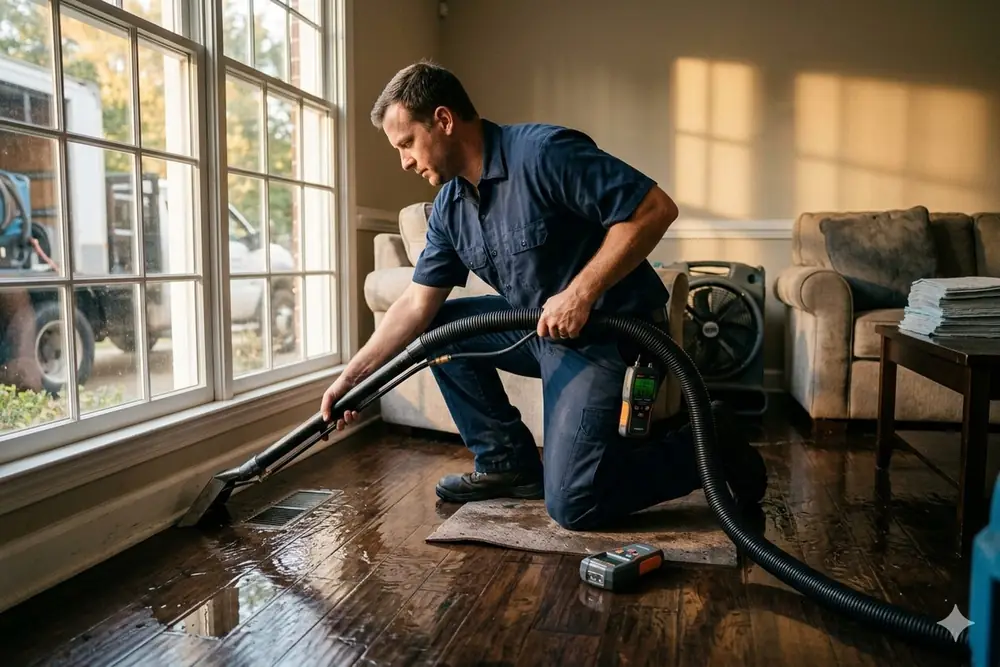
Water Damage Restoration - Fiber, Backing, and Padding Each Behave Differently
Carpet Water Damage Restoration Charlotte NC
Carpet Water Damage Restoration Charlotte NC treats carpet as three separate materials stacked together, the visible fiber, the backing underneath it, and the padding below that, each of which holds and releases water differently. A carpet that feels only slightly damp on top can still have padding underneath that's fully saturated, which is usually the deciding factor in whether carpet gets cleaned in place or needs to come up entirely.
[Call Now] · Free on-site assessment · Direct insurance billing · Available 24/7
Carpet is one of the more forgiving materials after a water event if it's addressed quickly, but padding is not. Padding acts almost like a sponge, holding far more water than the carpet fiber above it, and once padding has been wet for more than a day or so it rarely makes sense to dry and reuse it rather than replace it.
✨ What Carpet Restoration Actually Involves
What Carpet Water Damage Restoration Charlotte NC Covers
The first step is extraction directly from the carpet and padding using equipment designed to pull water out of fibers, not just off the surface. A wet-dry shop vac barely scratches the surface compared to a truck-mounted extraction unit built for this specific job.
Delamination is one of the main risks with wet carpet. Many carpets are constructed with a secondary backing glued to the primary backing, and prolonged water exposure can break down that adhesive, causing the layers to separate. Once delamination happens, the carpet typically can't be saved regardless of how well it's dried afterward.
Tack strips along the edges of a room, along with the carpet's stretch, are also affected by water. Wet tack strips can lose their grip, and carpet that's been saturated and then dried sometimes shrinks slightly, leading to a looser fit that needs to be re-stretched during reinstallation.
What to Expect During a Carpet Restoration Call
- Extraction equipment designed specifically to pull water out of carpet fiber and backing
- An assessment of whether padding underneath can be dried or needs to be replaced
- A check for delamination or backing separation before deciding whether carpet can be saved
- Re-stretching and reinstallation if carpet is dried and reused rather than replaced
What Happens If Wet Carpet Sits Too Long
Padding left wet for more than about 24 to 48 hours is unlikely to be salvageable, since it tends to hold onto moisture and start developing odor even after the surface carpet feels dry. Beyond the padding itself, moisture trapped underneath carpet for an extended period increases the risk of subfloor damage and mold underneath.
Why a Rented Carpet Cleaner Isn't Enough
A rental carpet cleaner is built to clean, not to extract standing water from saturated padding. Running one over wet carpet after a flood or leak typically just pushes water around rather than removing it, and it does nothing to address padding that's already holding significant water underneath.
🕒 How It Works
How It Works
Extract From Fiber and Padding
Specialized extraction equipment pulls water from the carpet fiber and, where possible, from the padding underneath before drying equipment is placed.
Assess Padding and Backing
A technician checks whether padding is salvageable and inspects for delamination, which determines whether carpet can be dried in place or needs to come up.
Dry, Re-Stretch, or Replace
Salvageable carpet is dried and re-stretched into place. Carpet or padding that can't be saved is removed and replaced as part of the repair phase.
✨ Two Materials, Different Fates
Carpet Restoration vs Hardwood Floor Water Damage Repair
Carpet and hardwood respond to water in almost opposite ways. Carpet padding tends to fail quickly once saturated, often needing replacement even when the carpet itself survives. Hardwood is slower to show damage but can suffer longer-term structural changes, cupping, buckling, that don't always show up until well after the water is gone, which changes the timeline for each material's restoration decision.
✨ A Typical Call
A Typical Carpet Restoration Call in Charlotte
A common call follows a slow leak under a bedroom carpet from an adjoining bathroom, discovered only when the carpet starts to feel soft underfoot. In cases caught within a day, the carpet and even some of the padding can often be saved with prompt extraction.
Another frequent scenario involves a finished basement where a sump pump failure allows an inch or two of water to spread across the carpeted floor. Given how basements trap moisture, padding in these cases is almost always replaced even when the carpet on top can be cleaned and reused.
A third scenario comes from a slow, ongoing leak that went unnoticed for over a week, where the carpet has already started to delaminate near the wet area. In this situation, the affected section of carpet typically needs full replacement rather than restoration.
Trained to Judge Salvageable vs Not
Deciding whether carpet and padding can be saved takes more than a quick feel of the surface. Technicians are professionally trained to check for delamination, test how padding responds to extraction, and judge whether re-stretching will hold once carpet has dried and potentially shrunk slightly.
⭐ Real Customers
What Charlotte Customers Say
"They were upfront that the padding was a lost cause but the carpet itself could be saved, which saved us from replacing the whole room."
"Caught our bedroom leak early enough that extraction alone handled it without needing to pull anything up."
"The re-stretch after drying made our basement carpet feel tight again instead of loose and wavy."
Carpet restoration is available throughout Charlotte and nearby communities including Steele Creek, Ballantyne, and Rock Hill, with the same extraction and assessment process used across the metro.
❧ FAQ
Frequently Asked Questions
Can wet carpet always be saved?+
Not always. It depends on how long it was wet, whether the water was clean or contaminated, and whether the backing has started to delaminate.
Does the padding under carpet always need to be replaced?+
Usually, yes, if it was wet for more than a day or so, since padding holds water like a sponge and rarely dries back to a usable condition.
How can you tell if carpet has delaminated?+
Delamination often shows as the backing separating or bubbling when the carpet is lifted, and it typically means the affected section needs to be replaced rather than dried.
Will carpet shrink after being dried out?+
Some carpets can shrink slightly after significant water exposure, which is why re-stretching is often needed to restore a tight, even fit.
How soon does carpet need to be addressed after a leak?+
Ideally within 24 to 48 hours. Beyond that window, both the carpet and especially the padding become significantly less likely to be salvageable.
Does carpet restoration include cleaning stains after drying?+
Extraction focuses on removing water, but a final cleaning pass is often included once drying is complete to address any residual marks.
What if only part of the carpet in a room got wet?+
Restoration can sometimes be limited to the affected section, though matching a partial replacement to existing carpet isn't always possible depending on age and availability.
Is contaminated water carpet treated differently?+
Yes, carpet exposed to contaminated water is generally not dried and reused. It's removed and replaced along with the padding underneath.
Why Carpet Decisions Get Made Fast
Carpet and padding change condition faster than most other building materials after a water event, which means the window for deciding whether to dry and save versus remove and replace is shorter than it is for drywall or flooring. A crew experienced with carpet restoration in Charlotte can usually make that call within the first assessment rather than waiting to see how things develop.
How Charlotte Basements Affect Carpet Restoration Decisions
Below-grade basement spaces common in parts of the Charlotte area hold humidity longer than an above-ground room, which makes drying carpet and padding in a basement less reliable than the same materials upstairs. That's part of why basement carpet more often ends up replaced rather than dried, even when the water event itself was relatively minor.
A Few More Things Worth Knowing
- Furniture is typically lifted onto blocks or moved during extraction to avoid staining or further compressing wet carpet
- Odor from wet carpet that lingers after drying is usually a sign padding should have been replaced rather than dried
- Area rugs and carpet are treated differently, since rugs can often be removed entirely for off-site cleaning and drying
Need Carpet Water Damage Restoration Charlotte NC Now?
Free assessment of what can be saved, with fast extraction from both carpet and padding whenever the timing allows it.
The sooner wet carpet gets extraction, the better the odds of saving it instead of pulling it up entirely.
[Call Now]
- Licensed, bonded, and insured for your protection
- We work your insurance claim for you
- A written plan before any labor starts
- No hidden fees, not once
Send Us Your Details
Prefer not to call right now? Tell us what's going on and a member of our team will follow up with next steps for your property.
Every submission goes straight to our team at info@waterdamagenorthcarolina.com — most people hear back the same day.