Home / Blog / Water Mitigation vs Restoration: What's the Difference and What Do You Actually Need?
Water Damage North Carolina BlogWater Mitigation vs Restoration: What's the Difference and What Do You Actually Need?
Water Mitigation vs Restoration: What's the Difference and What Do You Actually Need?
If you have ever typed water damage restoration into a search bar in a moment of panic, you have probably seen two terms used almost interchangeably: mitigation and restoration. They sound like two ways of saying the same thing, but in the industry they mean two different phases of work. Confusing them is not just a vocabulary problem. It can affect how you hire help, what you tell your insurer, and what you expect the bill to cover.
Water mitigation is the emergency response. It is everything done to stop the damage from getting worse: getting the water out, drying the structure, and removing what cannot be saved. Water damage restoration is everything that comes after: repairing and rebuilding so the home looks, functions, and smells the way it did before the water arrived.
In North Carolina, where summer humidity keeps building materials damp longer and tropical systems can push storm water into homes from Charlotte to the coast, understanding this split helps you make faster, better decisions. This guide explains each phase, what they cost on a national basis, and how to tell which one your home actually needs.
The Short Answer
Mitigation stops the damage. Restoration fixes what the water already damaged. Mitigation includes water extraction, moisture mapping, structural drying, dehumidification, and removal of unsalvageable materials. Restoration includes replacing drywall, flooring, cabinets, trim, paint, and anything else that drying alone cannot fix. You almost always need mitigation first, and you may or may not need restoration afterward, depending on how much the water touched.
What Is Water Mitigation?
Mitigation is the emergency phase. Its goal is not to make your home pretty again. Its goal is to stop the loss from spreading and to stabilize the environment so that mold, rot, and structural damage do not get a head start. Think of it the way you would think of first aid: nobody confuses first aid with surgery, but both can be necessary, and they happen in a specific order.
The industry standard that defines this work is the ANSI/IICRC S500 Standard for Professional Water Damage Restoration, which classifies water by category (how contaminated it is) and describes the drying and extraction procedures professionals follow. Mitigation is the portion of that work concerned with controlling the environment: water removal, moisture detection, drying, and dehumidification.
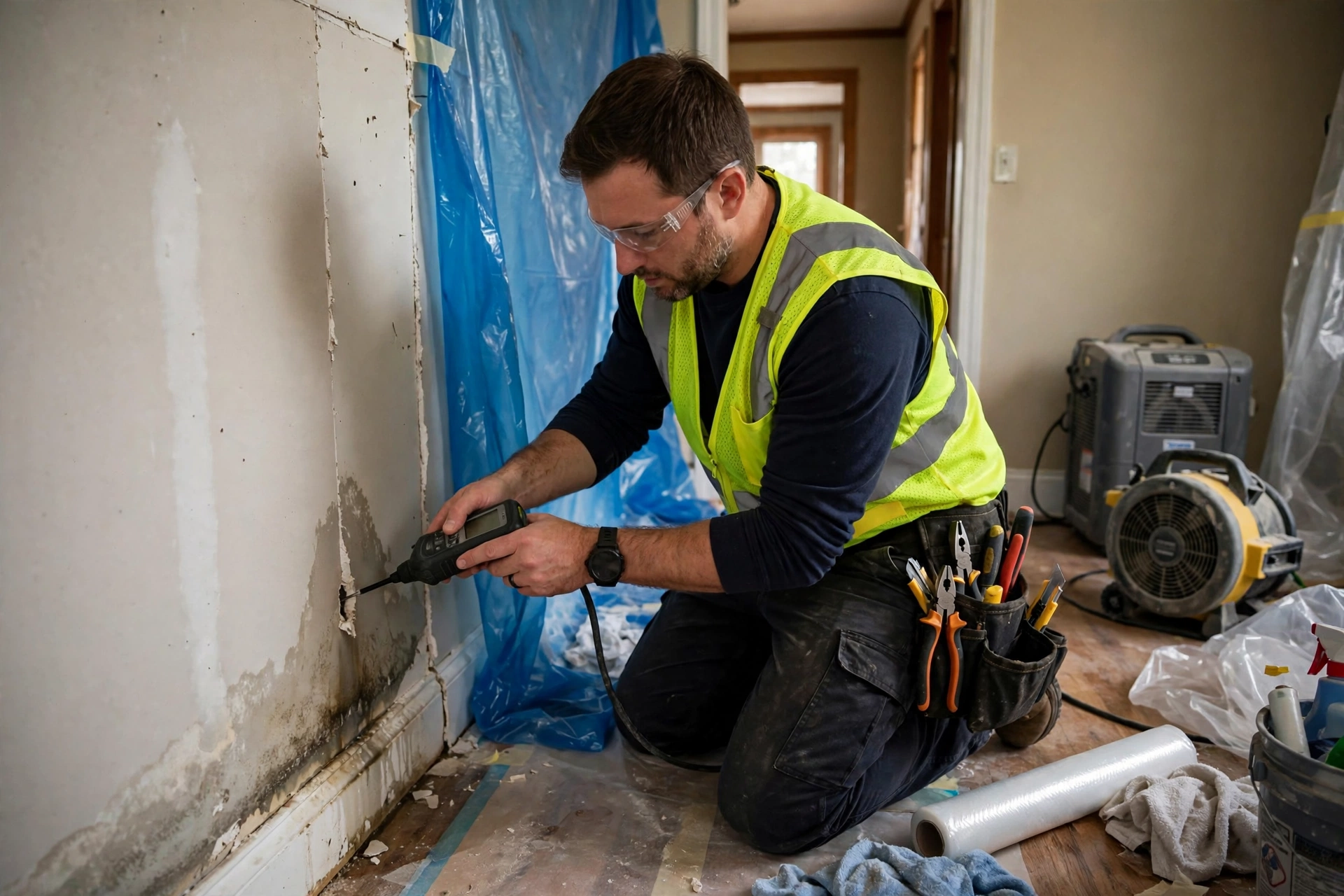
In practice, mitigation starts with an assessment. A technician inspects the affected area, uses moisture meters and sometimes infrared cameras to map how far the water traveled, and determines the water category. Category 1 water comes from a clean source, such as a supply line. Category 2 is significantly contaminated, often from appliances like dishwashers. Category 3 is grossly contaminated and includes sewage and floodwater. The category matters because it determines what can be saved and how aggressively materials must be removed.
What Mitigation Typically Includes
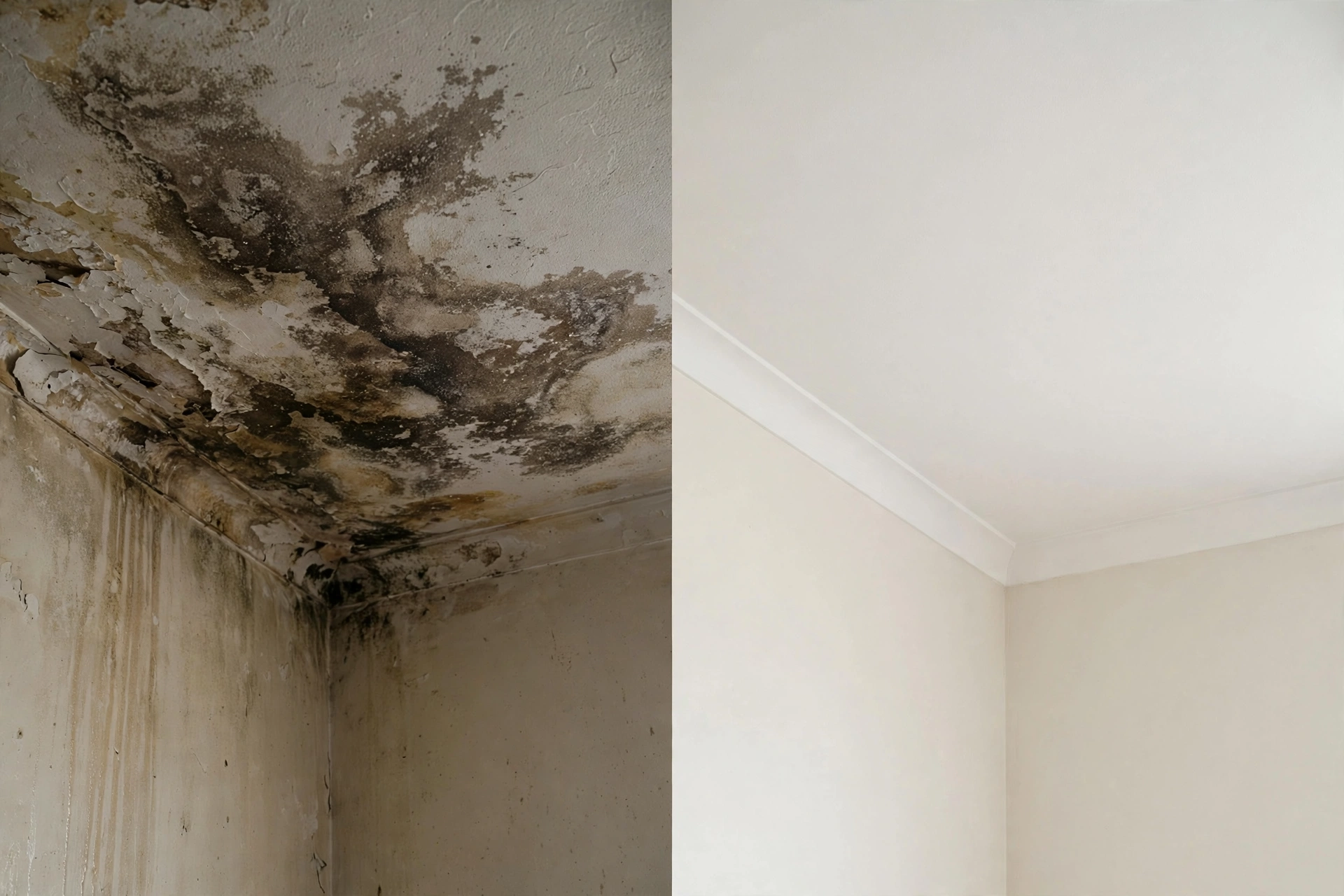
Emergency water extraction. Standing water is removed with extraction units and, in basements or crawlspaces, with submersible pumps. This is usually the first physical step and the most time sensitive, which is why emergency water extraction is treated as a rapid-response service.
Moisture mapping and monitoring. Meters and thermal imaging show where water wicked into walls, under flooring, and into framing. Drying targets are set from this data, not from guesswork, and readings are logged over the course of the job.
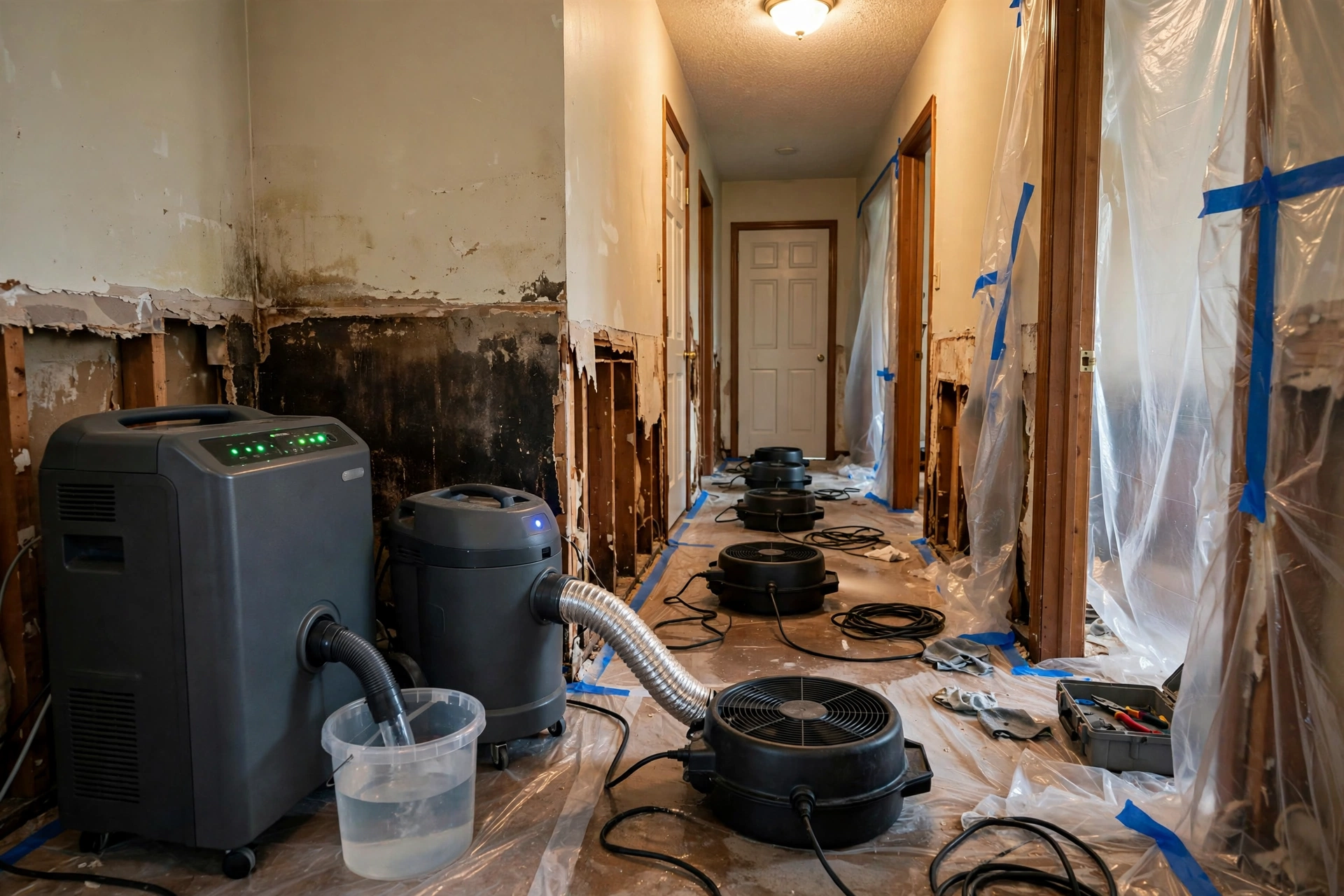
Structural drying. High-velocity air movers and commercial dehumidifiers run for days to pull moisture out of framing, subfloor, and drywall. Equipment is sized to the space and repositioned as moisture levels fall. This is the core of professional structural drying services.
Removal of unsalvageable materials. Padding, wet insulation, saturated drywall, and swollen laminate usually cannot be dried reliably, so they are cut out and removed. This is mitigation, not restoration: removal happens now so drying can succeed, even though replacement comes later.
Cleaning and sanitizing of affected surfaces. Particularly after Category 2 or 3 water, exposed framing and hard surfaces are cleaned and treated before drying finishes. After storm-driven flooding, this step overlaps with post-flood sanitization work, and contaminated contents may require flood-damaged furniture removal before drying can proceed.
What Is Water Damage Restoration?
Restoration begins once the structure is dry and stable. Its goal is to return the property to its pre-loss condition, which means repairing or replacing everything the water damaged that drying alone could not fix. If mitigation is first aid, restoration is the full recovery plan.
Restoration work looks like ordinary renovation: new drywall where sections were removed, new flooring where it buckled, new cabinets and trim, fresh paint, and sometimes new subfloor, insulation, or framing. It can be as small as repainting one room or as large as rebuilding several rooms after a major flood. Unlike mitigation, restoration is rarely an emergency in the same sense. It cannot start until moisture readings show the structure is dry, because installing new materials over a damp frame traps moisture and invites mold.
One common point of confusion is where contents fit in. Items removed during mitigation for access or contamination are handled through the whole process: drying and cleaning of salvageable contents can run alongside structural drying, while replacement of what was lost is finalized during restoration.
Real talk: some companies blur this line on purpose, quoting one big number without saying which phase covers what. Always ask for the mitigation scope and the restoration scope as separate line items. If a quote cannot separate them, that is a sign to get a second opinion.
What Restoration Typically Includes
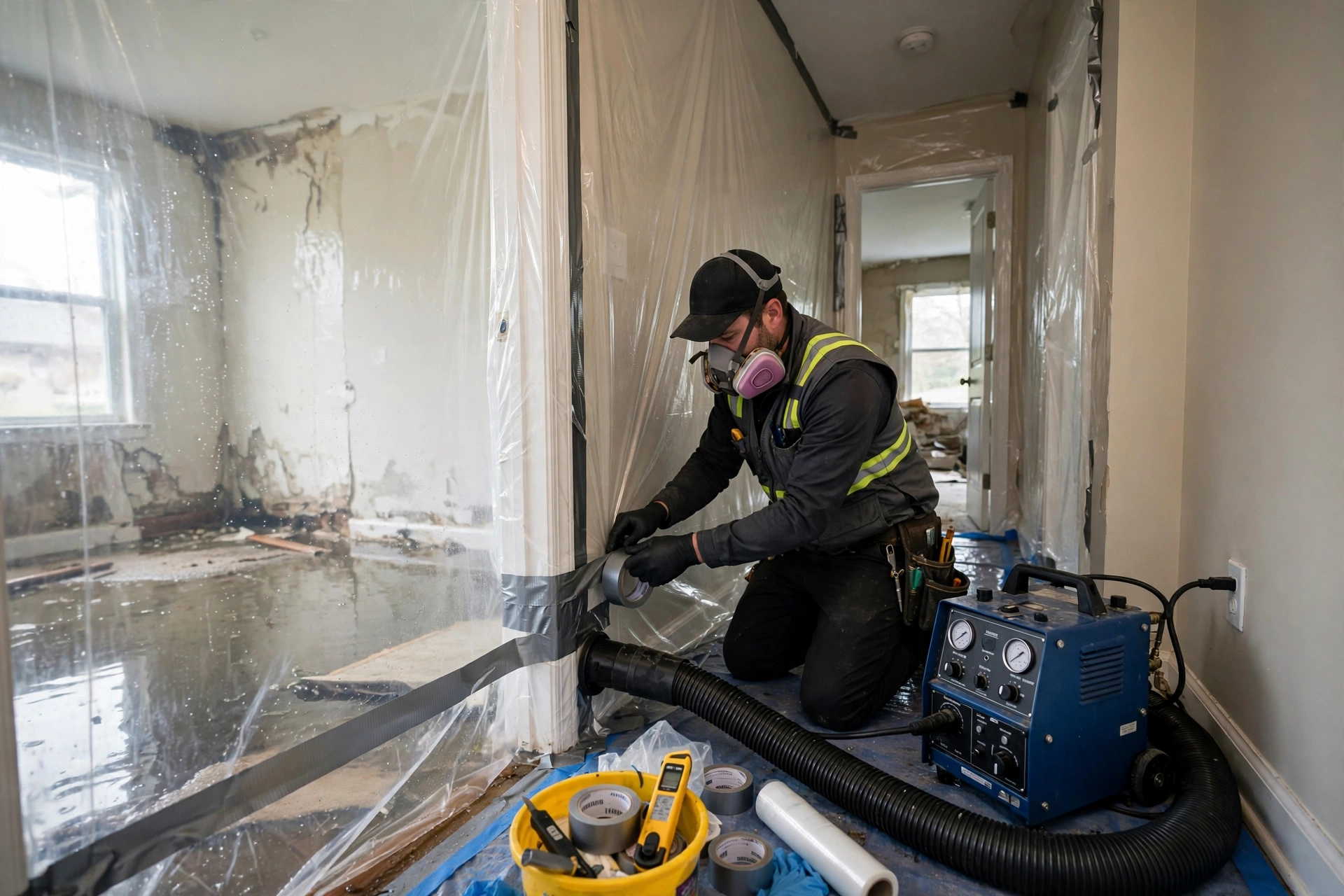
Demolition of damaged finishes. Drywall, flooring, baseboards, and trim that were removed or damaged during mitigation are taken out fully, and the remaining structure is inspected once more before anything new goes in.
Structural repair. Framing, subfloor, or sheathing that was compromised gets repaired or replaced. In the crawlspaces common across North Carolina, this can include joist work or subfloor replacement where water sat for an extended time.
Replacement of finishes. Drywall, texture, paint, flooring, cabinets, countertops, and fixtures are installed to match the home as closely as possible. Residential water damage repair focuses on returning living spaces to normal, while commercial water damage restoration also has to account for business downtime and code requirements for commercial properties.
Final verification. Moisture readings confirm the building is dry before finishes are installed, and a final walkthrough checks the finished work against the pre-loss condition.
Mitigation vs Restoration: Side by Side
Here is the comparison in one place, since this is the question most homeowners actually ask:
| Mitigation | Restoration | |
|---|---|---|
| Goal | Stop the damage from spreading | Return the home to pre-loss condition |
| When | Immediately, hours to days after the event | After drying is verified complete |
| Activities | Extraction, moisture mapping, drying, dehumidification, removal of unsalvageable materials, sanitizing | Drywall, flooring, cabinets, trim, paint, structural repair |
| Typical duration | 1 to 5 days of active work, plus drying time | Days to weeks, depending on scope |
| Emergency? | Yes, time is the whole point | No, it waits for verified dry readings |
Why Mitigation Always Comes First
You cannot rebuild on a wet house. Moisture trapped inside walls and framing feeds mold and rot regardless of how nice the new drywall looks. That is why every credible plan starts with mitigation, verifies drying with meter readings, and only then schedules restoration.
This order also protects your insurance claim. Insurers expect to see mitigation documented: photos, moisture logs, and equipment records. Skipping straight to repairs without documentation can make it harder to prove what the water caused versus what pre-existing wear explains. A professional water damage assessment at the start creates the record everything else depends on.
There is one minor exception to the order. After a very small, clean-water event that was caught within hours on a hard surface (a supply-line drip on tile, for example), the fix may be handled in a single visit. But even then, the area has to be confirmed dry with meters before anything is closed up. If a contractor suggests covering a wet area without drying it first, that is not efficiency. That is how mold gets a head start.
North Carolina Factors That Change the Plan
North Carolina adds a few wrinkles that make the mitigation-restoration split more important, not less.
Humidity slows everything. Summer relative humidity across the state routinely sits high enough that building materials release moisture slowly, which extends drying time. Equipment runs longer, and drying logs matter more, because a room that feels dry to the touch can still read wet inside the wall cavity.
Mold clocks run fast. In North Carolina heat, mold can begin growing on damp organic materials within 24 to 48 hours. That timeline is a national guideline, but it bites harder here because of the climate. Fast mitigation is the difference between drying a wall and cutting it out.
Crawlspaces are everywhere. Much of the state's housing stock sits over vented crawlspaces, which are classic trouble spots: standing water, damp soil, and limited airflow. Drying a crawlspace requires different equipment placement and often more time than drying a slab room of the same size, and inspectors know to look there first.
Storm systems do not ask permission. From tropical moisture pushing up from the Gulf and Atlantic to afternoon thunderstorm cells that stall over a county, North Carolina homes face both flash-flood events and slow-seep events. Flash floods push Category 3 water into homes, which changes the mitigation plan entirely: more removal, more sanitizing, less salvage. Coastal and river-adjacent cities like Wilmington see this pattern regularly, but inland flooding around places like Winston-Salem and Asheville after heavy rain systems can be just as destructive.
Common Scenarios: Which Service Do You Need?
1. Burst supply line, clean water, caught quickly. Almost always: full mitigation, minimal restoration. Extraction and drying handle the water itself, and restoration may be limited to replacing a section of drywall or flooring. The right first call is emergency water extraction, not a remodeler.
2. Storm floodwater inside the home. Always: full mitigation plus likely extensive restoration. Floodwater is Category 3, which means porous materials it touched generally cannot be salvaged. Water damage cleanup removes the contamination, structural drying services dry what remains, and restoration rebuilds what was removed.
3. Roof leak during a storm. Usually: mitigation for the wet areas, moderate restoration. The leak path through insulation and ceiling drywall often means ceiling sections must be replaced even after the roof itself is repaired. Drying the attic and wall cavities matters as much as fixing the visible stain, because a stain you can see sits on top of moisture you cannot.
4. Sewage backup. Always: full mitigation with sanitization, plus restoration of whatever was removed. Sewage is Category 3 water with real health risks, so sanitizing is part of mitigation, not an optional add-on. Porous materials in contact with it are removed rather than cleaned.
Many real situations are combinations. A storm can push floodwater through a basement while a wind-damaged roof leaks into an upstairs bedroom, which means one event produces two different mitigation plans and two different restoration scopes. This is another reason the assessment matters: a walkthrough maps every affected area and its water category, so the plan matches the actual damage instead of the first thing anyone noticed.
What Does Each Cost? National Averages
Costs vary enormously by region, water category, square footage, and how long the water sat before anyone responded. That said, national averages give you a frame of reference before anyone visits your home.
Mitigation alone for a contained incident often runs in the low thousands nationally, with extraction and several days of drying equipment being the main cost drivers. Restoration is where totals climb: drywall, flooring, and cabinets add up fast, and a multi-room rebuild can reach the mid five figures nationally. For a serious whole-home event, the two phases together commonly exceed either one alone.
What drives the bill up: Category 3 water (more removal, more sanitizing), delayed response (more material loss), finished basements and higher-end finishes (more to replace), and mold that established itself before drying started. What keeps it down: fast response, clean water, hard surfaces, and catching the problem early.
Real talk: nobody can price your job from a phone call or a photo. Anyone who does is guessing, and guesses favor the guesser. A real estimate comes from an on-site assessment with moisture readings. If a number arrives before the meters do, treat it as advertising, not pricing.
Insurance Claims in North Carolina: The Basics
Standard North Carolina homeowners policies generally cover sudden and accidental water damage, like a burst pipe, but typically exclude flood damage, which usually requires separate flood insurance through the National Flood Insurance Program. Gradual damage from long-term leaks is usually excluded as a maintenance issue rather than a covered event.
Two practices protect any claim you do file: mitigate promptly and document everything. Insurers carry a duty-to-mitigate expectation, meaning that if you let water sit, coverage for the resulting damage can be disputed. Photos, moisture logs, equipment records, and a dated assessment report are the evidence your claim rides on. Keep every receipt, and do not authorize restoration work you expect the insurer to cover until you understand your deductible and whether the work needs prior approval.
How to Tell What Your Home Needs
Ask three questions. First, is it still wet? If moisture meters still read elevated, you need mitigation. Second, what did the water touch? If it touched porous materials under Category 2 or 3 conditions, expect removal and restoration. Third, is anything damaged that drying cannot fix? Buckled floors, swollen cabinets, sagging drywall, and visible mold all point toward restoration after drying is verified.
When in doubt, the assessment comes before the decision. You can learn more about Water Damage North Carolina or reach out through our contact page for a professional assessment in the Charlotte area. If water is still entering the home, call (855) 951-5633 for emergency help.
Frequently Asked Questions
Can I skip mitigation and go straight to repairs?
No. Repairs installed over damp materials trap moisture inside the wall or floor assembly, which leads to mold and rot behind the new finishes. Mitigation and verified dry meter readings have to come first. Any contractor who offers to skip straight to rebuilding is skipping the step that protects the work they are about to sell you.
Does every water loss need full restoration afterward?
No. Small clean-water events that are caught fast, such as a supply-line drip on tile, often need only mitigation: extraction, drying, and monitoring. Restoration becomes necessary when materials were damaged beyond what drying can fix, which is common with Category 2 and 3 water, soaked drywall, buckled flooring, and anything mold colonized.
How long does each phase take?
Mitigation typically involves 1 to 5 days of active work plus the drying period, which depends on the materials and the climate. In North Carolina humidity, drying can run longer than the national average. Restoration ranges from a few days for one room to several weeks for a multi-room rebuild, depending on scope and material lead times.
Will my insurance pay for both mitigation and restoration?
For covered sudden and accidental losses, insurers generally pay for reasonable mitigation costs and for restoring the resulting damage, subject to your deductible. Flood damage is typically excluded from standard policies and requires separate flood insurance. Document everything from day one, because the mitigation records are what prove the loss was handled properly.
Is floodwater really different from a burst pipe?
Yes, fundamentally. A burst supply line is Category 1 clean water, and much of what it touches can be dried and saved. Floodwater is Category 3: it carries soil, chemicals, and sewage contaminants, so porous materials it touched are generally removed rather than salvaged, and sanitizing becomes a core part of mitigation.
How do I know my home is actually dry?
Through moisture meter readings compared against the dry standard for each material, logged over multiple days. Feeling dry is not a measurement. Professional drying logs show the readings falling to acceptable levels across walls, floors, and framing before restoration begins, and those logs are also the documentation your insurer wants to see.
References
- Institute of Inspection, Cleaning and Restoration Certification. (2021). ANSI/IICRC S500: Standard for professional water damage restoration (5th ed.). Mount Prospect, IL: Author. https://www.iicrc.org
- Institute of Inspection, Cleaning and Restoration Certification. (2015). ANSI/IICRC S520: Standard for professional mold remediation (3rd ed.). Mount Prospect, IL: Author. https://www.iicrc.org
- U.S. Environmental Protection Agency. (2012). A brief guide to mold, moisture, and your home (EPA 402-K-02-003). https://www.epa.gov/mold/brief-guide-mold-moisture-and-your-home
- U.S. Environmental Protection Agency. (n.d.). Flood cleanup: Avoiding indoor air quality problems. https://www.epa.gov/indoor-air-quality-iaq/flood-cleanup-avoiding-indoor-air-quality-problems
- Centers for Disease Control and Prevention. (n.d.). Mold. https://www.cdc.gov/mold/
- Federal Emergency Management Agency. (n.d.). Floods. https://www.ready.gov/floods
- National Flood Insurance Program. (n.d.). FloodSmart: The official site of the NFIP. https://www.floodsmart.gov
- North Carolina Department of Environmental Quality. (n.d.). https://www.deq.nc.gov
Water damage can't wait.
Available 24/7 across Charlotte and North Carolina. Call (855) 951-5633 now for help day or night.